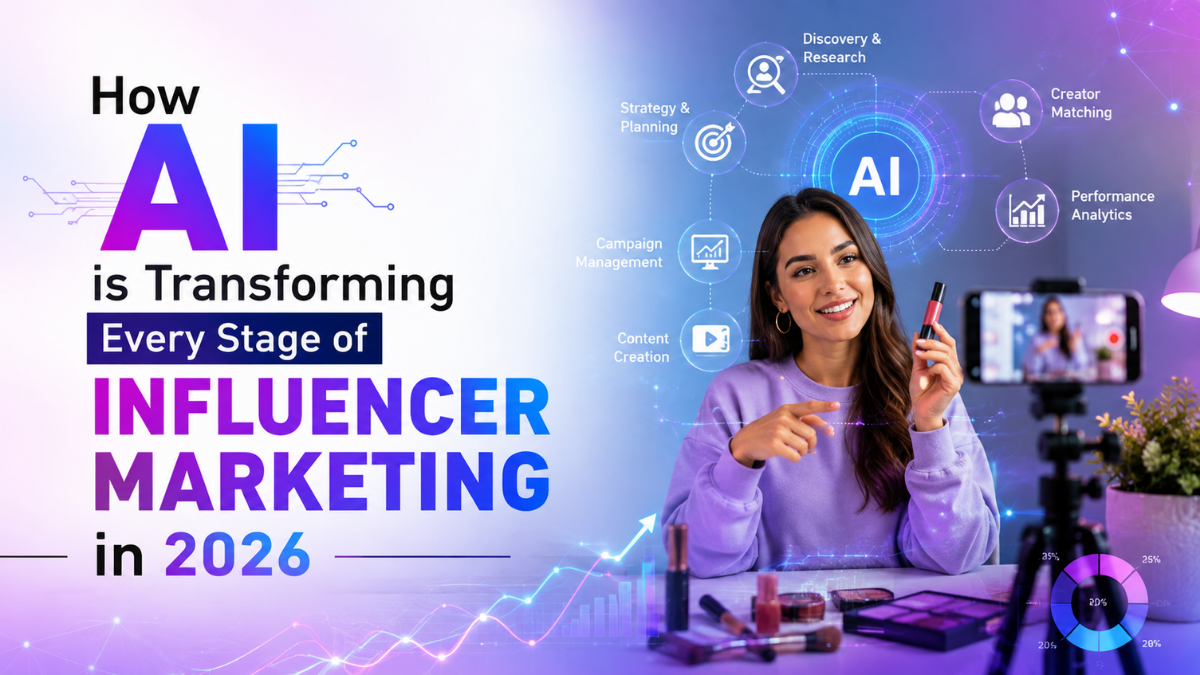
Influencer marketing has changed a lot in just a few years. What once started with celebrity endorsements and sponsored Instagram posts has now become a serious digital marketing channel for brands.
And in 2026, there is a new player changing the game: Artificial Intelligence (AI).
From finding the right creator to predicting campaign performance, generating content ideas, analysing audiences, and measuring ROI, AI is becoming part of almost every stage of influencer marketing.
But does that mean AI is replacing influencers?
Not really.
AI is making the process smarter and faster, while human creativity, personality, authenticity, and storytelling remain at the heart of influencer marketing.
For brands working with an Influencer marketing agency in Mumbai, understanding how AI is changing the industry can help them create campaigns that actually connect with today's social-first audience.
Why AI Matters in Influencer Marketing in 2026
The creator economy is growing rapidly. According to the IAB Creator Economy Ad Spend & Strategy Report, U.S. creator advertising spend was projected to reach $37 billion in 2025, growing by 26% year over year.
At the same time, influencer marketing itself has become a major global industry. Influencer Marketing Hub estimated the global influencer marketing industry at around $24 billion in 2024.
These numbers show one thing clearly: brands are investing heavily in creators.
But with millions of creators, multiple social platforms, huge amounts of content, and increasingly demanding audiences, manually managing every part of an influencer campaign can become overwhelming.
That's where AI enters the chat.
1. AI Makes Influencer Discovery Smarter
Finding an influencer isn't simply about checking their follower count anymore.
A creator with 20,000 highly engaged followers can sometimes be more valuable than someone with one million passive followers.
AI-powered tools can analyse factors such as:
- Audience demographics
- Engagement rates
- Content categories
- Audience interests
- Previous brand collaborations
- Follower authenticity
- Content performance
- Brand-creator relevance
This helps brands move from "Who has the biggest following?" to "Who has the right audience for us?"
That's a major shift.
For an Influencer marketing agency in Mumbai, AI can make creator discovery more efficient while allowing marketing teams to spend more time on strategy and relationships.
Also Read: Top Influencer Marketing Agencies in Mumbai
2. AI Helps Brands Find the Right Creator-Brand Fit
A successful influencer campaign is about more than numbers.
The creator's personality should match the brand.
For example, a Gen Z skincare audience may respond better to a relatable beauty creator who regularly shares honest routines than to a celebrity who rarely discusses skincare.
AI can analyse previous content, audience interests, engagement patterns, and campaign data to identify potential creator-brand matches.
Think of it as matchmaking, but for brands and creators.
The final decision still needs a human touch, but AI can make the shortlist much smarter.
3. AI Is Changing Content Creation
This is probably the most visible change.
Creators are already using AI for brainstorming hooks, captions, scripts, video concepts, content calendars, image generation, editing, subtitles, and translations.
Instead of spending hours staring at a blank screen thinking, "What should I post today?", creators can use AI to generate multiple ideas in seconds.
But there's an important rule:
AI can create the draft. Your personality creates the connection.
Audiences can quickly notice when content feels robotic, overly polished, or copied.
The best influencer content in 2026 will combine AI efficiency with human creativity.
4. AI Helps Predict What Content Could Perform
Remember when creators had to post something and simply hope it would go viral?
Those days are slowly changing.
AI can analyse historical campaign data and identify patterns in content performance.
It can help marketers understand:
- Which content formats perform best
- What topics generate engagement
- Which posting times work better
- What type of audience responds to a campaign
- Which creators consistently deliver results
This doesn't mean AI can guarantee virality.
There is no "make this go viral" button.
But data-driven insights can reduce guesswork and help brands make better decisions.
5. AI Is Making Personalisation Easier
One campaign doesn't always need to look exactly the same for everyone.
AI can help brands understand different audience segments and create more personalised influencer strategies.
For example, a fashion brand could work with different creators for different communities, cities, age groups, or interests.
One creator might focus on streetwear, another on luxury fashion, and another on affordable everyday styling.
Instead of one message for everyone, brands can create content that feels more relevant to specific audiences.
And Gen Z notices relevance.
If content feels like a generic advertisement, the scroll is almost automatic.
6. AI Makes Campaign Measurement More Powerful
Likes and followers are no longer enough to prove that an influencer campaign worked.
Brands want to know:
Did we get results?
AI-powered analytics can help marketers analyse campaign metrics such as:
- Reach
- Engagement
- Views
- Clicks
- Conversions
- Audience sentiment
- Cost per engagement
- Return on investment
This allows brands to understand which creators and content formats are actually contributing to business goals.
For an Influencer marketing agency in Mumbai, advanced analytics can also make campaign reporting more transparent and useful for clients.
7. AI Can Help Detect Fake Engagement
Fake followers and artificial engagement have always been major concerns in influencer marketing.
A creator may have thousands of followers, but that doesn't necessarily mean those followers are real or active.
AI and data-analysis tools can identify unusual engagement patterns, suspicious follower growth, bot-like activity, and inconsistencies between audience size and engagement.
This gives brands another layer of protection when choosing creators.
However, technology should support human verification rather than completely replace it.
8. AI Is Making Influencer Marketing More Scalable
Perhaps the biggest advantage of AI is speed.
Tasks that previously required hours of manual work can increasingly be automated or assisted by AI.
Research, creator discovery, campaign analysis, reporting, content ideation, and audience insights can all become faster.
That allows marketing teams to focus on the things AI can't truly replace:
relationships, creativity, strategy, storytelling, and cultural understanding.
What Does This Mean for Influencers?
AI isn't necessarily the enemy of creators.
In fact, creators who learn how to use AI effectively may have a serious advantage.
The winning combination is likely to be:
Human creativity + AI efficiency + authentic storytelling.
Creators can use AI to save time while still keeping their unique voice, experiences, humour, opinions, and personality at the centre of their content.
Because let's be honest, people follow creators for their vibe, not just their content calendar.
Also Read: How the Fashion Industry Is Redefining Beauty Standards
The Future of Influencer Marketing Is Human + AI
AI is transforming influencer marketing, but it isn't removing the human element.
Technology can analyse data, generate ideas, identify patterns, and automate repetitive tasks. But it cannot completely replace the emotional connection between a creator and their audience.
That connection is what makes influencer marketing powerful in the first place.
For brands, the future is not about choosing between AI and influencers.
It's about using AI to help influencers and marketing teams work smarter, faster, and more strategically.
And for businesses looking to build effective creator campaigns, partnering with an experienced Influencer marketing agency in Mumbai can help combine technology, creator expertise, and human-led campaign strategy.
Also Read: Why D2C Brands Need Professional Models in 2026
Conclusion
AI is transforming influencer marketing across almost every stage of the campaign journey, from finding creators and evaluating audiences to creating content, measuring performance, and identifying potential risks.
However, the technology works best when it supports rather than replaces the human side of influencer marketing.
The most successful campaigns in 2026 will combine AI-powered insights with authentic creators, strong storytelling, strategic thinking, and genuine audience connections.
For brands looking to build effective campaigns, an experienced Influencer marketing agency in Mumbai can help bring together technology, talent, and campaign strategy.